Ambient Voice Technology in Social Care: What Practitioners Need to Know Before Adopting It

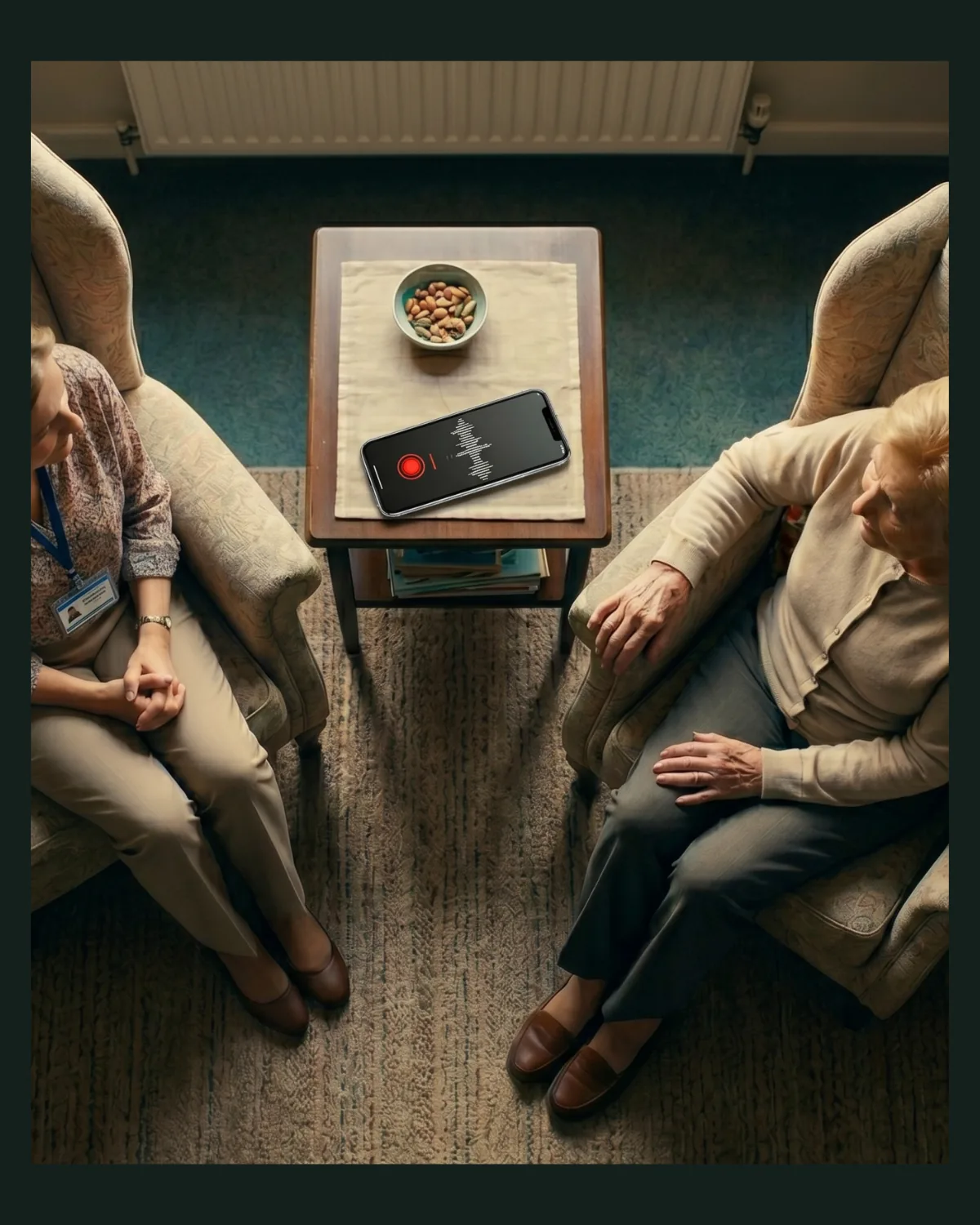
Ambient voice technology is moving into adult social care faster than the training to use it. It listens to a conversation between a practitioner and a person who draws on care, and it drafts a record from what it hears: a Care Act assessment, a mental capacity assessment, a visit note. The pitch is time saved, and that pitch is genuine. What is usually missing is a plain account of how these tools work and where they can let you down, written for the person who will put their name to the output.
I spoke about this on a UKDHC webinar in June 2026 with Joanne Preston, an advanced social work practitioner at Nottingham City Council. A good deal of what follows came out of that conversation.
How AVT actually works
It helps to know what is happening behind the screen, because the mechanism is the reason for the risks.
Most AVT products are not building their own AI. They are wrappers around established third-party engines, and which engine you are using depends on what the vendor has chosen and is paying for in the background. The voice processing might run on one company's model and the drafting on another's. Speaker recognition works much as Teams does: the system listens for the natural gaps and breaks in how we talk to work out who is speaking and when.
Then comes the part that looks like magic and is not. You choose the template you want, a Care Act assessment for example, and a prompt sits behind that template out of sight. The system breaks your conversation into pieces and drops each piece into the section it decides it belongs in. If you have talked about moving and handling, it will most likely place that in the mobility section. It is pattern-matching speech to a form, and it hands back something that reads like a finished assessment.
That last sentence is the whole point. The tool has produced a tidy draft from patterns in speech. It has not understood the conversation, applied the Care Act 2014, or weighed someone's capacity under the Mental Capacity Act 2005. You do that.
Why the mechanism is the risk
Once you can see that AVT is sorting speech into boxes, the ways it falls short become clear. It can place something in the wrong box, so a comment about a recent fall, dropped in while you were talking about something else, might land in general notes rather than the risk section where it belongs. It can flatten nuance, because capacity that fluctuates through the day is the kind of careful, conditional finding a template prompt will tend to round into something firmer than you actually said. It can also carry detail that was never there, because a model built to complete a template will lean towards filling a section rather than leaving it empty.
None of this is unusual. Background noise, accents, people talking over each other, and the non-verbal communication that tells you most of what you need to know in a front room, these are exactly where voice processing struggles, and they are not edge cases in social care. They are the work.
Automation bias, and why good formatting makes it worse
The deeper risk is how trustworthy the output looks. A draft that arrives complete, structured and professionally worded is harder to question than a blank page. That pull to accept it is automation bias, and a confident, well-formatted record is precisely the kind of output it feeds on. I have written about automation bias separately, because it is the first thing I would want any team adopting AI to understand.
Reporting has already documented voice and transcription tools inventing content and misrepresenting what was said in care and clinical settings. The lesson from those cases is not that the tools are useless. It is that the failure is hard to see. Checking a summary tells you whether what is on the page is right. It does not tell you what the tool left off the page to produce something so clean, and in social work the missing line is often the one that mattered.
The audio is the part people forget
Because these tools run on third-party engines, the conversation does not stay between you and the person in front of you. The recording is processed elsewhere, and often the most sensitive thing in the whole exchange is the raw audio, not the assessment it produces. Before AVT goes anywhere near a visit, you need to know where that audio goes, which companies process it, whether it leaves the UK, how long it is kept, and who can reach it. The note has a retention policy. The recording needs one too, and it should not outlive its purpose.
Consent, capacity and UK GDPR
Recording a conversation with someone who draws on care is processing their personal data, and usually special category data. Three things need to be settled before the first recording, not after.
The first is a lawful basis and real consent. People should understand they are being recorded, what the recording is for, and that they can decline without it affecting their support. Consent given because someone felt unable to say no is not consent. Where the capacity to make that decision fluctuates or is in doubt, that is a Mental Capacity Act question in its own right, and a family member or advocate being present does not remove it.
The second is transparency. Everyone in the conversation, including anyone else in the room, should know the tool is in use. The third is a Data Protection Impact Assessment. Under UK GDPR, a new technology processing sensitive data at this scale needs a DPIA completed before rollout, and that assessment is the natural place to answer the data and retention questions above.
Keeping your own voice in the record
A Care Act assessment is a legal document, written in a professional voice. When the first draft is generated for you, the risk is that your reasoning recedes and the template's phrasing takes its place. Your voice in the record is not a matter of style. It is the evidence that a qualified person observed, weighed and decided, and it is what holds up when the record is later questioned. The accountability for every word stays with you, whoever or whatever drafted it first. This is the principle the TESSA Responsible AI Framework is built around, and it is why I treat AI use as a literacy rather than a shortcut.
This matters more in this sector than in most. Social Work England and Research in Practice reported in 2025 that the majority of social workers qualified in the last five years have had no AI training at all, and only a small minority have any ethical guidance to work from. AVT is landing into that gap: high adoption, low preparation.
Questions worth asking before you adopt
Put these to the provider, and to your data protection lead, before anything is signed off:
- Which third-party engines process the voice and draft the text, and where are they based?
- What happens to the audio after the note is generated, and how long is it retained?
- Can we see the prompt that sits behind each template, and can we adjust it?
- How does the tool handle consent, and what is the process when someone declines or lacks capacity?
- What training comes with it, and does that training cover how the tool fails, not only how to use it?
A short checklist for practice
- Read every output against what actually happened in the conversation, not against whether it reads well.
- Treat the draft as a starting point you edit into your own professional voice, never a finished assessment to sign.
- Confirm the lawful basis, consent process and DPIA before the first recording.
- Make sure your team has had real training, not just a login.
AVT is not the end of professional documentation, and it is not a threat to social work. It is a tool that drafts. The judgement, the legal responsibility, and the relationship stay exactly where they have always been, with you.
You can watch the full UKDHC session on ambient voice technology in social care, or read more about how I think about safe AI use in the TESSA Responsible AI Framework.
Common questions about AVT in social care
What is ambient voice technology in social care?
AVT records a conversation and drafts a structured record from it, such as a Care Act or mental capacity assessment, by mapping the transcript onto a template using a prompt that sits behind it.
Is AVT safe for Care Act assessments?
It can support them, but the practitioner must review and take responsibility for every section. The tool drafts; it does not assess or apply the Care Act 2014.
Do you need consent to record people who draw on care?
Yes. People should understand they are being recorded and be free to decline without it affecting their support. Where capacity to consent is in doubt it becomes a Mental Capacity Act question, not a tick box.
Where does the audio go?
Often to third-party engines that may sit outside the UK, because most AVT products run on external AI services. Establish processing, retention and access in a Data Protection Impact Assessment before use.
Can AVT replace a social worker's professional judgement?
No. It drafts from speech patterns; the legal and professional accountability for the record stays with the practitioner.
References and Further Reading
UKDHC. (2026). Using Ambient Voice Technology (AVT) in Social Care. Webinar featuring Nadia Hajat and Joanne Preston. https://youtu.be/J3UG1dEnz6Q
Care Act 2014, c.23. legislation.gov.uk. https://www.legislation.gov.uk/ukpga/2014/23/contents
Mental Capacity Act 2005, c.9. legislation.gov.uk. https://www.legislation.gov.uk/ukpga/2005/9/contents
Information Commissioner's Office. Data Protection Impact Assessments (DPIAs). https://ico.org.uk/
Social Work England and Research in Practice. (2025). AI and the social work workforce. https://www.socialworkengland.org.uk/
Nadia Hajat is an independent social worker and Professional Doctorate researcher at Nottingham Trent University, investigating AI implementation in social work practice. She is the founder of TESSA Tools.
For training and consultancy enquiries: get in touch here or book a free call at calendar.app.google